
Showing posts with label Random Thoughts. Show all posts
Showing posts with label Random Thoughts. Show all posts
Tuesday, May 26, 2009
On Miscegenation and Prop 8
Interracial Marriage in the U.S.
This webpage offers an interactive map showing which states restricted interracial couples during every year from 1662 and 1967. Users can change the years and states by simply clicking selectively. It's awesome.
. . .
Today, the California Supreme Court upheld a voter-approved ban on same-sex marriage.
However, does majority rule justify appropriate decision-making? History has shown us that the will of the majority does not always make things right. In light of California's anti-miscegenation laws of the 19th and early 20th centuries, if Californians were polled at that time, a majority would have voted in favor of prohibiting miscegenation/interracial marriage. However, the morally upright decision was to allow people to marry whomever they want.
These anti-miscegenations laws were specifically designed to ensure white purity and to prevent any white Americans from trespassing the color line.
Asian Americans, in particular, have faced shocking effects of this adherence to the color line in the Cable Act (1922-1936). The Cable Act specifies that any U.S.-born woman marrying a "person ineligible for citizenship" would automatically lose her U.S. citizenship. It is important to note that the ONLY race and hence only aliens "ineligible for citizenship" at that time were Asian immigrants. Therefore, our nation's earliest anti-miscegenation laws were specifically aimed at Asians, using both the Cable Act and anti-miscegenation laws that prevent Asians and whites from marrying.
Fortunately, with time comes change. The Supreme Court of California was wise enough in 1948 to acknowledge how unlawful anti-miscegenation laws are. The Perez vs. Sharp decision ruled against anti-miscegenation laws, claiming that they were based on racial distinctions that were "by their very nature, odious to a free people."
Today, interracial marriage is accepted almost anywhere with anyone in the United States. Even individuals who do not necessarily want their son/daughter to marry across the racial divide would be hesitant to turn back Loving vs. Virginia. People today consider marriage to be a private affair between two consenting adults.
Marriage, as an institution, is one of the most conservative, traditional, and entrenched institutions we have. Marriage leads to a more stable society and same-sex unions, by virtue of it being the same type of institution, also stabilize society. What will de-stabilize society is fear for the unknown and hatred toward the outer norm. People should be given a chance to enter this stabilizing institution in whatever form they choose: heterosexually or homosexually. I hope that one day in the not so distant future, our society will adopt a more tolerant attitude toward same-sex marriage. In the future, I hope citizens will reflect on California's upholding of Prop 8 to be a draconian and antiquated move.

Thursday, May 21, 2009
Eye To Eye but not Heart To Heart: Cultural Gaps in Understanding

Racial Microaggression in the Classroom
It was both intimidating and awkward. The second grade teacher was trying so hard to welcome me to class. I had just recently arrived in America. The teacher used what he thought was the one-size-fits-all communication approach to create rapport with people and he was resolutely abiding by the rules of this sticky approach. He believed that "good eye contact" was important to demonstrate camaraderie so he tried every trick to meet my eye. He called my name, paused, and tried to meet my eye. He asked me direct questions, paused, and tried to meet my eye again.
However, I was not used to the eye contact thing at all and was unknowingly successful in countering my teacher's well-intended altruism. I would divert my eyes away from my teacher's. I would stare at the ceiling, mutter an answer, glare at the ground, at my shoes, out the window, and mumble something inscrutable again.
Non-verbal communication, such as eye contact, is a constituent of the methods we present information using various modalities. Culture-specific differences are both physical and behavioral. The choice of colors and patterns in our clothing, and the inflections in our voice offer manifold layers of meaning and interpretation aside from their culture-specific significance. The color red has positive overtones in some cultures, and considered unlucky in others. Direct eye contact is perceived as showing sincerity in some cultures and deemed disrespectful in others. In order to localize notions of amity with a global friendship circle, we must be open to variations from the "rules" we are used to. We must learn to adjust our comfort zone of what is appropriate and what is right.
The sending and receiving of non-verbal messages usually occur on a subliminal level, which makes intercultural communication even more challenging to master. It is very easy to misinterpret a message simply because we do not understand its meaning outside our cultural context. Coming from China, a culture that views direct eye contact as disrespectful, I did not want to reciprocate my teacher's "rude" behavior. However, in my new environment, America, a culture that associates eye contact with openness and positive engagement, my teacher was sincerely trying to make me feel comfortable and at home in my new setting. When I averted his eye contact, he probably misinterpreted my action as being impolite, that perhaps I am hiding something, did not know how to respond, or most optimistically, that I am shy. He ignored my mutters and interrupted me at his convenience, as similarly re-enacted in the "Talking Athabaskan" video we saw in class in order to get what he wanted: reciprocated eye contact. We cannot assume that a behavior learned in our local environment has the same significance in other cultural settings.
Unfortunately, foreigners often have a less than positive impression regarding Americans. Americans are viewed as arrogant, pushy, insensitive, rude and informal. Americans do tend to be more informal than people from other countries. It is more common for Americans to wear casual clothing to school and greet teachers by their first names. Nevertheless, good manners and courtesy are always stressed in every situation. In the classroom, though I might have misinterpreted direct eye contact as a sign of disrespect ("glaring") by my peers and instructors, most Americans (and Westerners) do not intend to communicate rudeness by their behavior. Instructors not from Western cultures teaching American students need to understand that American students show their respect in different ways. For example, students show respect by having good attendance and by participating actively in classes. Furthermore, punctually completing homework assignments communicates responsibility. When students ask questions, they are demonstrating interest to their teachers. When they look their teachers in the eye during interactions, they are showing dynamic engagement. Most American instructors will interpret these behaviors as signs of respect and will respect their students in return.
Likewise, other cultures that avoid eye contact (e.g. Asian cultures) do not intend to show disrespect by averting eye contact ("lack of attention or interest"). This communication style can give the impression of lack of courtesy, lack of self-esteem, or lack of trustworthiness. The reality is that these students are not demonstrating lack of the knowledge in discussion or hiding other knowledge relevant to the interaction. They do not have an introverted personality. The cultural image of the Asian American model minority student only worsens the classroom intercultural relations. Asian students are viewed as know-it-alls, especially in math and the hard sciences (Sue: "Racial Microaggressions"). Furthermore, they are seen as schemers, often trying to circumvent the conventional institutional rules to boast their academic or social standing. Lastly, these students are perceived as shy and unresponsive, not engaged in the classroom and contributing to the learning dynamics. However, all these cultural stereotypes cannot simply be imposed on nonverbal communication. Students may choose to avert eye contact because this is a sign of respect in their native cultures. Their home culture communication and interaction differ from dominant patterns experienced in American schools. By avoiding eye contact, the students are merely allowing the speaker to feel most comfortable speaking.
In order to remedy the cultural divides in non-verbal communication, we must first become aware of the issue. We must acknowledge that we can send powerful messages non-verbally and that our messages will be interpreted differently in different cultures in various contexts. In addition, we have to become aware of our own behavior patterns and become observant of those in other people. We need to anticipate how others will react to our behavior and vice versa. We must learn to be comfortable with accepting silences and diverted eye contact, adjust our personal space and respond in a similar fashion as our acquaintances. In the classroom, teachers must be culturally accountable. They should know about students' cultural knowledge, convey content-specific/culture-specific knowledge, build on familial cultural experiences, local values, and communicative norms. Our intercultural camaraderie can be improved if we take small steps to strike a balance in communicative competence with our counterparts.
Eye contact is crucial in everyday interactions; after all, it is one of the first things people use to form an impression of you! However, there are many different eye contact styles specific to various cultures and environments. Through eye contact, people are unconsciously signaling to us how they wish us to behave towards them and we are doing the same to them. Our noncompliance to their signals and them to ours will lead to misinterpretation and misjudgments. In order to create positive rapport with our peers, we must learn to adjust our comfort zone of contact. Only when we understand other cultures and how they truly differ can we recognize how misunderstandings can easily result from simple differences in perspectives. At least the second grade teacher acknowledged that I had just emigrated from another country. At least I realized that I was no longer in China.
Tuesday, May 12, 2009
Dialect: Neither “Good” Nor “Bad” But “Different”

Precursor To Megan's presentation: "Language and Identity"
"I seen him," says the Black, blue-collar, high-school dropout. "I saw him," insists his White, college-educated manager. "I saw him" is Standard English, a sentence structured according to the grammar rules taught in educational institutions and demanded of in public society. Some people who hear a vernacular dialect different from Standard English may make false judgments about the speaker's acumen and ability. There is a prevalent notion that Standard English is proper English and superior to other forms; it is the dialect with greater social prestige and power. Those who speak Standard English are viewed as cultured and educated. Like race and class, dialect is a marker of group membership. Standard English is the dialect most often used in print and is what we and foreigners learn in school. In this sense, it is "better" in that it is more useful for wider communication and mutual understanding. In a language as widely spread and globally used as English, there is immense value in speaking the standard dialect. However, using another dialect is not "wrong" and should not be deemed inferior.
The speaker using the vernacular dialects in the wrong place at the wrong time with people who do not appreciate such differences will immediately be classified according to certain labels, most likely, pejorative ones of being uneducated and unrefined. Ebonics or "Black English" is often viewed as the inability of certain urban individuals, especially poor Blacks, to conjugate the verbs "to be" and “to see” (among many others) and to pronounce certain words incorrectly. People who speak a different dialect, whether it be Black English or British English, speak differently because they want to be able communicate with their peers, those whom they interact with on a regular basis (Jean Mills: "Connecting Communities: Identity, Language, and Diaspora"). They seek to be able to voice their opinions and thoughts in the most effective manner. They desire a dynamic flow of conversation and comfortable presence. Their communication variance does not make them any less of a person, a citizen, or a social being. They are merely not letting the constraints of language hold them back in free expression. These vernacular dialects are social dialects.
However, we cannot negate the historical reality that Black English did originate with poor Black Southerners in the Jim Crow era. They might have used phrases like "my baby's favva" and "I be chillin'!" However, these phrases and others have adapted through time, and have become expressions incorporated into certain individuals’ speech to make it more interesting and flow better. Black English symbolizes the comfort of home and camaraderie. Social dialects are unique and filled with colorful phrases and expressions. Just like American English is adapted from British English to fit the communication needs of this country, Black English should be understood and nurtured as a method of communication. Black English is simply a way of life. Those that speak it prefer to speak it most of the time and do not sense any “impropriety” in its usage. Those who prefer to be vegetarian are not any less human than those who are not. Many rich, educated and “cultured” individuals also speak Black English. Their choice of language is just another colorful marker about them. Dialect adds flavor and style to their day-to-day lives. They voice fresh perspectives and respond with unique ideas. The color of their skin, the texture of their hair, and the variation of their speech are all markers of beauty and the exquisite diversity that is America.
When users of Black English are in a different setting, say Downtowns and federal districts where there is a diverse mix of people, they are forced to speak Standard English. They are forced to conform to societal standards. The harsh reality is that for those who speak the dialect regularly, it is difficult to adapt because they feel a personal tie to their native dialect. Through this adaptation phase, these individuals are marked as “uneducated” because they have not fully conformed. They are forced to go into the work place thinking that the way they speak is fine and that it is acceptable. However, it is not acceptable in the work world and therefore, many of them cannot find decent jobs. The music and movie industries may make millions of dollars from exercising social dialects but even they are not immune to societal demands and have not done anything to improve the situation in the real ghettos or for the many poor folks who use this dialect for effective communication. By being exploited for their culture and dialect, Black English speakers can no longer thrive on being distinct and special because everyone is the same and one in speaking Standard English.
This is truly unfortunate. Dialects have been in existence for as long as language has been in existence. Dialects incorporates, borrows, and skews words and grammar structures of the standard dialect and renders them distinct and with specialized purposes. A dialect is an intelligent and insightful variation to the blandness of the standard language. Blacks and other speakers of the vernacular dialect, like everyone else, want a solid sense of their cultural identity. There is no scientific rationale to uproot Black English. Any professional linguist will testify that, as a language way of communication, Black English and Standard English are equal, in the same way that Italian and Chinese and French are all equal. They do things differently, in how they use words and grammar structures but there is no factual method to declare one is superior to the other.
To say that Black English is wrong and reflects uncouthness is erroneous and reflects the cultural ignorance of those who are making such shaky statements. It reveals the unwillingness of certain individuals, potentially white upper-class folks, to accept the idea of the “lower class” to have the intellectual capacity to actually develop a distinct and special dialect. Black English is neither the product of insufficient education nor counter-evolutionary. The proponents of such claims cannot be farther from the truth. Black English is not inferior but many people believe it is because its users, primarily black Americans, have a history of powerlessness. Society looks down upon the speech of the powerless. This has been demonstrated across history over and again. Of course, not all black Americans speak "Black English," nor do they all disdain Standard English. However, Black English is uniquely anchored in the black culture. We absorb this attitude unconsciously when we learn the English rules taught in school and view those who have not applied such “knowledge” as substandard.
The federal "No Child Left Behind" Act mandates closing the achievement gap between white and black students. However, why do black students score lower than whites on standardized tests in the first place? The reason lies in their nonconformity to Standard English, the language used in these tests. This also explains why there is a disparity even both groups are in equally wealthy and racially integrated schools. Intelligence needs to be analyzed in a more encompassing context. This is crucial as tests reveal other measures of intelligence beyond dialectal preference. For example, in the 1960s, the renowned sociolinguist William Labov discovered that some of the most brilliant, verbally gifted and socially skilled youths in the study spoke a dialect different from Standard English.
The misperception that Black English is bad English is scientifically baseless and it needlessly leads some students to under-perform in schools. Therefore, schools and other social institutions need to accept and embrace vernacular dialects while acknowledging the standard one. If we want to decrease alienation from school and mitigate stereotype threat, we should teach what is appropriate — that Standard English should be taught but that a student’s native dialect is also appropriate as a derivative base for adaptation, instead of rooting it out. It would be great if these students can be taught, "The school language here is called standard American English. It may be different from your native language or dialect but it is no better or worse than your language. Standard English serves to unite all Americans.” Students should be granted the opportunity to switch between the two dialects. The teaching of Standard English should be coupled with appreciation of dialect diversity (Students’ Right To Their Own Language). No dialect is better than the other; they all convey meaning in their own ways. By giving students information about various dialects, including their own, instructors can demonstrate the integrity that is language and the melting pot that is America. This approach elucidates the interrelationship between standard and social dialects, undermines the social basis for evaluation, and reinforces the pragmatic justification for using a standard dialect.
Fortunately, as Black English receives more and more worldwide exposure through multimedia, it bears the potential to transform itself from being perceived as American culture to being accepted as a foundation of American culture. However, since Standard English is the "common language" and one we are taught in school and used to intercommunicate with diverse Americans, we should be aware of its propriety and acknowledge what is taught and what is shared. If America wants to sustain as a melting pot, it is crucial that we assimilate under a unified language – Standard English. "I saw him" and "I seen him" reflect neither linguistic superiority, nor stupidity on the part of those who use "I seen him" but it demonstrates a literal and not derogatory sense of ignorance. By saying "I seen him," users are not acknowledging the grammar taught in school, the common dialect typing a melting pot of people, and at the fundamental level, all the efforts (hiring teachers, building schools, etc) and resources (financial and social) exerted to ensure the processing and application of the unified tongue. Rightly or wrongly, students are expected to master Standard English in order to perform well on standardized tests, succeed in school, and “move up” in the social ladder. For the sake of establishing and maintaining a career within corporate America or almost any career in this country for that matter, individuals need to be able to use the Standard American English. It is virtually impossible and an uphill battle to maintain a vernacular dialect considering the diversity of individuals among you in different situations when socially mobilizing. I do not believe that individuals should stop using Black English but rather have the ability to diglossically adapt depending on their settings.
Wednesday, May 6, 2009
More Thoughts on Being Asian American
I arrived to the U.S. from China/Hong Kong at the age of 7, speaking fluent Cantonese Chinese. Now, I can speak English fluently but have lost much of my Cantonese language fluency. When I first arrived, I found the categorization of Asian American very strange and counterintuitive. Why would I want to share my identity with a Japanese American, Korean American, etc? I have spent my entire life among Chinese people. Not only are these other Asian ethnic groups not my backyard neighbors but historically, tensions among many East Asian countries have not been the most stable. Furthermore, what connection can be tied between a Filipino American and an Indian American, a Hmong American and a Mongolian American?
However, after settling in the United States for a good number of years, I realize that not many Americans consider me as I considered myself: Chinese American. I have gradually come to acknowledge that Asian Americans get lumped as one group, as perpetual foreigners, regardless of their English proficiency or length of stay in America. It is this threat to my individuality (ironically enough) that makes me ever more proud of affiliating myself as Asian American. Many ethnic Asians, too, gradually come to form communities that stand in solidarity with one another to fight for civil liberties and social justice. By banding together, we can distill our individual strands of ethnic vitality.
Being Asian American yet having experiences with both cultures allows me to not tolerate linearity of association and perpetuating bias (David Pollock's, Third Culture Kids).
Friday, April 24, 2009
A Tree Grows in Brooklyn
a poem on pride and prejudice, about a young man denied
one and bestowed the other. taken from my poetry blog.
Down the street, sneakers hang from cable lines.
Along cement walls are graffiti gang signs.
One never walks alone here;
One is never without fear.
Brooklyn: where felons advance their career;
Brooklyn: where the innocent disappear,
A child dreams to become a pioneer.
In the media,
He is painted the shade of sin with the tone of threat,
The source of shame in a dark silhouette.
As if he is invisible yet ominously there,
Sprouting sin and fostering fear.
Roaming the mean streets of Brooklyn,
Grounds nourished in hate and bred for sin,
A child dreams to become a pioneer.
In this hood,
The crime-ridden projects of urban cityscape,
Day shines light on the sight of caution tape,
As the dreadful night before had taken shape
In the ugly forms of homicide and rape,
Of violent theft and victims’ futile escape,
In this vicinity of vice lived in constant fear,
A child dreams to become a pioneer.
In his family,
One might even say that the rumors hold truth,
As blood-kin behave in ways deemed uncouth:
An uncle on the run, and another behind bars,
His father charged for hijacking cars.
His older sister smokes pot outside the corner store,
As his little sister walks from behind to explore.
Yet he holds them dear and dreams to be the pioneer.
He is trampled by hollow assumptions,
Labeled with loathe and stamped with shame.
Using food stamps for daily consumptions,
He etches a living in his own name:
A student with perfect attendance,
And a fine scholar with straight A’s.
He is living with independence,
Fear overcome and peace embraced.
This child dreams to become a pioneer:
A brother who takes care of his sisters at will,
A son who makes his parents proud of him too.
A boy who, towards his ambitions, pursue,
Will one day find all his wishes fulfilled,
To become the man with his dreams come true.
The media can lie.
And people will die,
In this place where calm drowns into a cry,
And yet a tree grows high into the sky.
Living a life of fear with no despair,
A child dreams to become a pioneer.
Saturday, April 18, 2009
Asian vs Asian American
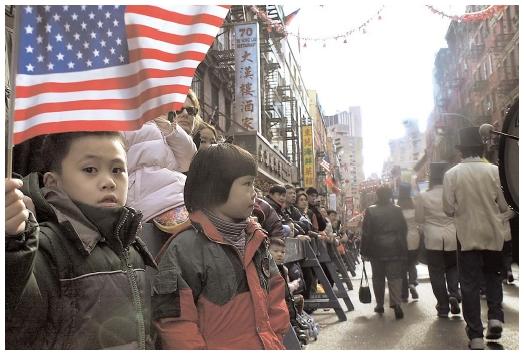
As I have discussed in an earlier post, I feel like I fit the fortune cookie analogy: yellow on the outside but both yellow and white on the inside. I am Asian American. I was, however, born in China so I did experience my fair share of being an immigrant. Being a Chinese, an immigrant, and an American, I am very interested in where these fine lines of separation lie and what turning markers blur these lines. When does an Asian immigrant become an Asian American?
Do Asians become Asian-Americans when they naturalize or does the transformation occur sooner, e.g. when they learn to combat Asian American issues, take on American values and standards, or become proficient in speaking English? By extension of the latter theory, do immigrants from English-speaking countries become Americans sooner than those who do not? If we hypothesize that becoming American relies not simply within a legal document, how can we hash out the traits that separate Asian from Asian American?
One can make the argument that Asian Americans are perpetually foreign in the United States (Sue: "Racial Microaggression"). They originate from lands where the languages and customs are vastly different from Western society's. Asian immigrants continue to roll in abundance to the United States, as well as countries all over the world yet they all share one commonality in their physical phenotypes: faces that irrevocably distinguish us as members of a minority race with recent origins in perpetually foreign countries. This physical identification factor may explain why many Asians believe that they neither have the ability nor the incentive to assimilate like European groups. When asked where they are from, Asian Americans would naturally reply "Boston," "New York" or another American location but unsatisfactorily to the inquisitor: "Where are you really from?" Despite this extra layer of assimilation barrier, many Asians have boldly tried to identify themselves as Asian American, for example, writer Ha Jin and musician Yo-Yo Ma.
Despite wanting to assimilate, wanting not to become a foreigner in our own country, Asian Americans themselves have blurred the lines between Asian Americans and Asians. Many members of the Asian American community, for example, have embraced famous Asians like Jackie Chan and Jet Li as their own. While these Asian celebrities may help publicize the Asian American community, they also reinforce the Asian stereotypes that Asian Americans generally do not want to be associated with: broken English, traditional Asian values, etc. What do Asian Americans want to be seen as? As someone who considers herself Asian American, I, too, will embrace stars like Jackie Chan as people who help elevate my "race" and bring it to public discourse. These people characterize the "Asian" in "Asian American" and their talents, values, and characteristics represent positively for all Asians and Asian Americans. However, I will be quick to identify other celebrities like Amy Tan or Michelle Kwan as well, individuals who are born in the U.S. or who have lived here for a number of years. These stars fully encompass Asian Americanism in their experiences with conflicting cultural values and generational divides, experiences that Asian Americans face (Cross' "Racial Identity Development Model").
I consider myself both Asian and American, hence Asian American. However, my parents generally see themselves as more Asian than American. We are all U.S. citizens and have been in America for the same number of years. However, I feel more emotionally tied to America; I have a heart-to-heart commitment to America that my parents lack. Emotional commitment sounds like a vague standard, but I think it is the best explanation for why some immigrants will never truly feel American despite temporal and locational associations. For example, individuals who moved to America against their will, like refugees, are not going to feel a sense of commitment to their new land. No matter how long they spend in America, they see America as a place of displacement and their native country as their true home. Being emotionally committed to a country is really open to interpretation. Once must feel a senses of national pride, of course, but I feel like the individual should also make a serious effort to learn the language (English), participate in civil society (e.g. vote or take on activism projects), associate with diverse people in America, carry appropriate emotions in national times of crises and triumphs, and feel a need to give back to America because it has afforded the individual certain rights and privileges. Because of all these malleable requirements, I feel more Asian American and my parents, more Asian.
What the individual thinks and what society thinks of the individual are often two very disparate notions but they definitely influence each other. When one starts to feel American and thinks he/she is American, then society will reciprocate these affections. Into the melting pot I go!
Thursday, April 16, 2009
A Thought
I am a student, daughter, sister, friend, enemy, nap enthusiast, caffeine addict, techno music lover, writer, artist, thinker, progressive, quirky, pint-sized, Bostonian.
I have black hair, brown eyes. I am YELLOW.
None of these things define me, but they are the building blocks of who I am.
I am the sum all these things, my parts, and who I am is more than a sum of these parts.
Monday, April 13, 2009
www.nathangibbs.com
I have recently stumbled upon a wonderful website: www.nathangibbs.com. Nathan Gibbs is a producer and artist who creates meaningful projects that explore color and culture in America. Two of his projects that I found to be extremely cool are:
1. "Crayola Monologues (2003) uses the crayon as a human metaphor for exploring color and identity in the United States. This animated video features crayons expressing how color hierarchies have shaped their lives. These crayons live in a world much like our own, complete with prejudice, class boundaries, social hierarchies and those who fall between the lines. Crayola Monologues also reveals the politics behind Crayola label changes, and gives a voice to the previously unheard perspective of crayons."
2. "Race Cube (2003) remodels the classic Rubik’s Cube with a racial twist. Rather than the abstract color separation of the original, the Race Cube poses a more concrete challenge: aligning images of people into categories based on race. Race Cube challenges not only the player’s ability to determine the race to which each face belongs, but also the fundamental assumption that distinct racial lines exist. Race Cube requires that subjects such as Tiger Woods be sorted in a binary paradigm, without any tolerance. Multiracial faces cannot sit simultaneously on multiple sides of the cube. The three dimensional grid structure of the cube represents the low tolerance, low-resolution construction of racial categories.At the same time Race Cube physically manifests the “problem” or puzzle of race, it also provides a solution. This perspective asserts that the cube is always in a constant state of solution. Race Cube maintains its ideal mixed state no matter how many adjustments one makes to the arrangement of the cube, regardless of the player’s attempts to solve the problem. This new solution views the biological notion of being mixed from a positive, rather than the traditionally negative, perspective. Validating diversity and the mixed state of racial representation today provides a platform for deconstructing biological myths about race."

Nathan, you rock!
Subscribe to:
Posts (Atom)